Housefly in Malaysia — The Disease Carrier
The housefly is one of Malaysia's most common and dangerous pests. Far from being a mere nuisance, houseflies are confirmed carriers of over 65 diseases — transferring pathogens from waste and sewage directly onto food surfaces, putting your health and business at risk.
For food businesses, a housefly presence in food handling areas constitutes a HACCP critical failure and MOH violation. For homes, they contaminate food and threaten the health of every family member. Effective control requires eliminating breeding sources, not just killing individual flies.
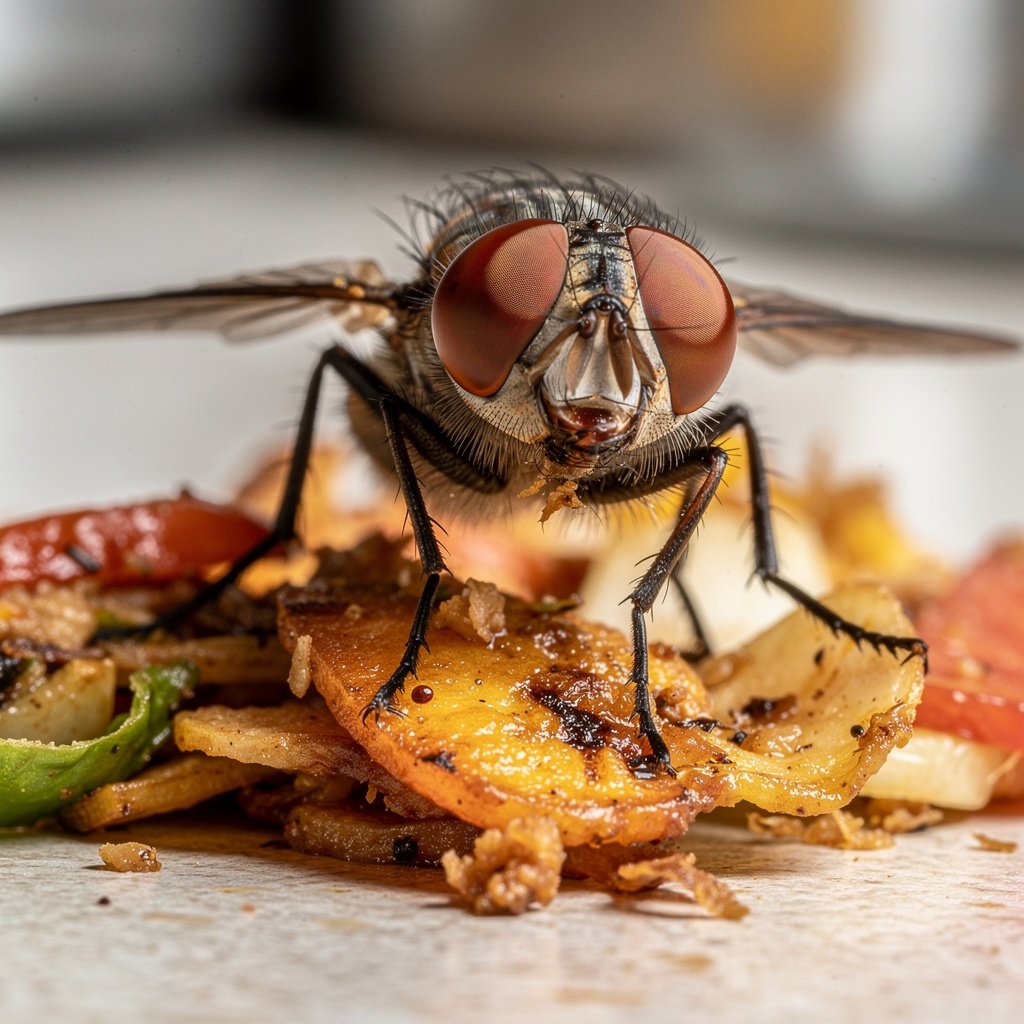
Musca domestica
Common housefly
Identification
What Is the Housefly?
The common housefly (Musca domestica) is the world's most widely distributed fly species — and Malaysia's most dangerous fly pest. Measuring 6–8mm in length, the housefly is immediately recognisable by its dull grey body, four dark longitudinal stripes on the thorax, and large, reddish compound eyes.
What makes the housefly uniquely hazardous is its feeding and breeding behaviour. Houseflies cannot bite or chew solid food. Instead, they regurgitate digestive fluids onto food to liquefy it before ingesting — in the process depositing bacteria from whatever surface they fed on previously, including rubbish bins, drains, animal waste, and sewage.
In Malaysia's tropical climate, houseflies breed continuously year-round. A female lays 400–600 eggs in her lifetime in batches of 100–150 on organic waste. In warm conditions, eggs hatch within 24 hours and the complete life cycle takes just 6–10 days — enabling rapid population explosions if breeding sources are not eliminated.
Size
6–8 mm — medium-sized fly
Colour
Dull grey, four dark stripes, reddish eyes
Behaviour
Fast, erratic flight; lands frequently on food and waste
Hazard
Regurgitates on food; carries 65+ disease pathogens
info Quick Facts
- Scientific name
- Musca domestica
- Family
- Muscidae
- Adult size
- 6–8 mm
- Lifespan
- 15–30 days (adult)
- Eggs per female
- 400–600 in lifetime
- Life cycle
- 6–10 days (egg to adult)
- Breeding sites
- Waste, manure, decaying matter
warning Disease Transmission Risk
A single housefly can carry millions of bacteria on its body and in its gut, transferring pathogens to food with each landing. Houseflies are linked to outbreaks of typhoid, cholera, dysentery, and salmonellosis — making them a public health priority in food environments.
Breeding Sources
Where Houseflies Breed
Housefly control must focus on eliminating breeding sources — the organic waste and decay that sustains the population cycle.
Commercial & Outdoor Sources
-
check_circle
Waste Skips & Rubbish Collection Areas
Uncovered or overfull waste containers near food businesses are major housefly breeding grounds — attracting flies from hundreds of metres away.
-
check_circle
Grease Traps & Drains
Grease traps and outdoor drains with accumulated organic waste provide warm, moist breeding conditions ideal for larval development.
-
check_circle
Animal Waste & Manure
Properties near livestock, wet markets, or areas with bird or pest activity have elevated housefly risk from adjacent manure and droppings.
-
check_circle
Food Waste Disposal Areas
Kitchen waste areas, composting zones, and uncleaned loading bays at food premises generate persistent housefly breeding populations.
Residential Breeding Sources
-
check_circle
Unsecured Household Bins
Kitchen bins without tight-fitting lids — especially those containing meat scraps, cooked food, and moist organic waste — are primary breeding sites.
-
check_circle
Pet Waste
Dog faeces and cat litter trays not cleaned promptly attract houseflies and provide breeding substrate, particularly in gardens and outdoor areas.
-
check_circle
Compost Heaps
Unmanaged garden compost heaps attract houseflies and enable breeding — particularly when meat, fish, or cooked food waste is included.
-
check_circle
Exposed Food & Spillages
Food left uncovered, spillages not cleaned immediately, and poor kitchen hygiene create both feeding and potential breeding environments for houseflies.
Detection
Signs of Housefly Infestation
High housefly activity in or around your home or business indicates a breeding source nearby — identify and act before populations escalate.
High Fly Activity Indoors
Multiple houseflies inside the premises — especially near food preparation areas, windows, or light sources — indicate active infestation nearby.
Maggots in Waste Areas
White larvae (maggots) visible in rubbish bins, waste areas, or near drains — a sign of active breeding with a new adult generation emerging within days.
Dark Spots on Surfaces
Small dark spots (fly specks — excrement) on walls, light fittings, and surfaces near resting areas indicate sustained fly activity at that location.
Clustering Near Windows
Groups of flies clustering near windows and skylights — attempting to exit — suggest the breeding source is inside the building or immediately adjacent.
Flies Around Light Fixtures
Dead or circling flies around indoor light fixtures — houseflies are strongly attracted to light and will circle lamps when resting populations are high.
Flies on Food Surfaces
Houseflies landing on food, counters, or food contact equipment is a direct hygiene and food safety emergency requiring immediate professional attention.
Risks
Health & Business Risks
Houseflies are among the most dangerous domestic pests — carrying pathogens that cause serious illness and creating serious liability for food businesses.
Disease Transmission
Houseflies transmit over 65 diseases including typhoid, cholera, dysentery, salmonellosis, and E. coli infections — by landing on food after contact with contaminated sources.
Food Poisoning Outbreaks
Food premises with active housefly populations face the risk of customer food poisoning, which can trigger health authority investigations and media exposure.
HACCP & MOH Violations
Houseflies in food handling areas are a HACCP critical control point failure. MOH inspectors treat fly activity in kitchens as a serious violation warranting immediate enforcement action.
Risk to Vulnerable Groups
Young children, elderly, and immunocompromised individuals are most vulnerable to diseases spread by houseflies — including diarrhoeal diseases and parasitic infections.
Customer & Reputation Damage
Visible fly activity in a restaurant, hotel, or retail food outlet drives away customers and generates negative online reviews that are difficult to reverse.
Rapid Population Growth
In Malaysia's climate, a housefly population can double in under 10 days. Without source elimination, treating adult flies provides only days of relief before numbers recover.
DIY Limitations
Why DIY Housefly Control Fails
Fly swatters, sprays, and sticky traps are no match for a sustained housefly infestation. Without addressing the breeding source, any reduction in fly numbers is temporary — populations recover within days.
Breeding Source Untreated
Fly sprays kill adult flies but do not affect eggs and larvae in breeding sites. New adults emerge continuously until the source is eliminated.
Insecticide Resistance
Housefly populations in Malaysia have developed resistance to many common insecticide classes, reducing the effectiveness of store-bought fly sprays.
Source Not Identified
DIY approaches rarely identify the specific breeding sources — particularly in commercial properties with complex waste streams, drains, and outdoor areas.
No HACCP Documentation
DIY fly control provides no audit documentation. Food businesses need certified pest control service records for HACCP compliance and MOH inspections.
check_circle Professional Advantages
- done Thorough survey to identify all breeding sources and entry points
- done Professional-grade insecticides applied to resting and breeding areas
- done ULV cold fogging for rapid knockdown in large commercial spaces
- done UV light trap installation and monitoring for ongoing fly activity data
- done HACCP-compliant service reports and pest activity records
- done Hygiene and sanitation recommendations to prevent reinfestation
Smart Pest Control
How We Eliminate Houseflies
Our integrated fly management program combines breeding source treatment with targeted adult knockdown and ongoing monitoring to deliver sustainable results.
Site Survey & Source Mapping
We conduct a thorough inspection of waste areas, drains, grease traps, food storage, and outdoor zones to identify and document all breeding sources and high-activity areas.
Source Treatment & Adult Knockdown
We treat breeding sites with professional larvicide formulations, apply residual insecticide to resting areas, and where required, deploy ULV fogging for rapid adult fly knockdown.
Monitoring & Ongoing Management
We install and monitor UV light traps, review trap counts on service visits, provide HACCP documentation, and advise on hygiene measures to maintain effective long-term fly control.
Treatment Methods We Use
Residual Spray
Long-lasting insecticide applied to resting surfaces, window frames, and waste areas to kill flies on contact over an extended period.
ULV Cold Fogging
Ultra-low volume cold fogging for rapid adult fly knockdown in large commercial spaces, warehouses, and outdoor areas.
UV Light Traps
Installed at entry points and food preparation areas to continuously attract and capture adult flies while providing population monitoring data.
FAQ
Frequently Asked Questions
How can I identify a housefly? expand_more
What diseases can houseflies spread? expand_more
Why are houseflies a serious problem for food businesses? expand_more
Where do houseflies breed? expand_more
How do I control houseflies effectively? expand_more
Housefly Problem at Your Home or Business?
Don't risk disease transmission or HACCP compliance failures from housefly activity. Our certified fly control specialists provide thorough source elimination and ongoing management with full audit documentation.