ISO 22000 Pest Control Integration
ISO 22000 is the global standard for Food Safety Management Systems, recognised across Malaysia and internationally. Integrating pest control effectively into your ISO 22000 system ensures compliance, protects certification, and demonstrates commitment to food safety excellence.
This guide explains how pest control fits within ISO 22000 requirements, what documentation auditors expect, and how to build a compliant pest management program.
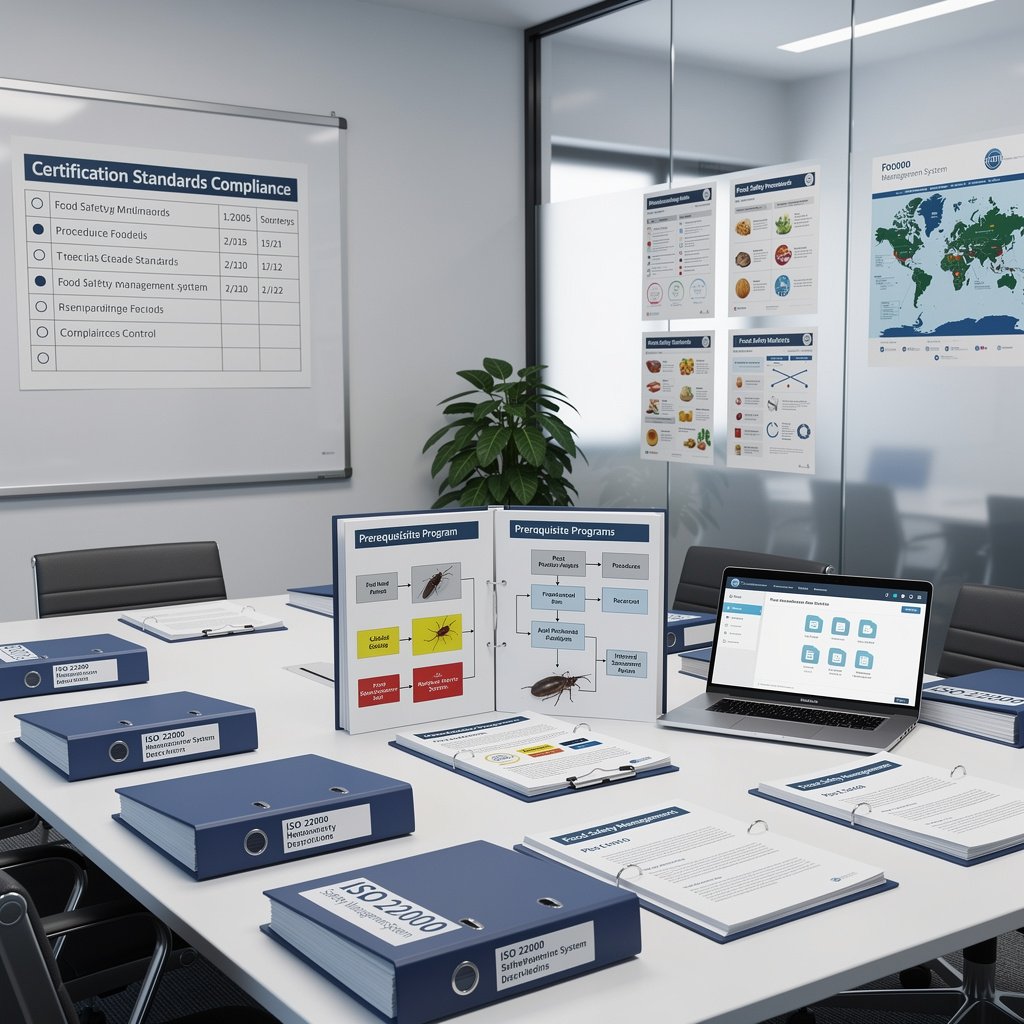
ISO 22000
Certified
Understanding ISO 22000
What is ISO 22000?
ISO 22000:2018 is the international standard that specifies requirements for a Food Safety Management System (FSMS). It combines the principles of HACCP with a comprehensive management system approach, applicable to any organisation in the food chain regardless of size or complexity.
Unlike HACCP alone, ISO 22000 requires documented management commitment, resource allocation, planned processes, and continuous improvement. Certification demonstrates to customers, regulators, and stakeholders that your food safety management meets international standards.
Key ISO 22000 Clauses
- checkContext of the organisation
- checkLeadership and commitment
- checkPlanning (hazard analysis, PRPs)
- checkSupport (resources, competence)
- checkOperation (PRPs, traceability)
- checkPerformance evaluation
- checkImprovement
High-Level Structure (HLS)
ISO 22000 follows the Annex SL high-level structure, making it compatible with other management system standards like ISO 9001 (Quality) and ISO 14001 (Environment). This integration capability is valuable for food businesses seeking multiple certifications.
Plan-Do-Check-Act (PDCA)
ISO 22000 operates on the PDCA cycle, requiring continuous planning, implementation, monitoring, and improvement of food safety processes including pest control.
Risk-Based Thinking
The standard requires proactive identification and management of risks and opportunities throughout the food safety system.
Process Approach
Activities are managed as interconnected processes that function as a coherent system, with pest control as a critical supporting process.
Prerequisite Programs
Pest Control as an Operational PRP
ISO 22000 requires pest control to be established, implemented, and maintained as an Operational Prerequisite Program (OPRP) or monitored as a CCP depending on hazard assessment.
Documented Procedures
Written pest control procedures covering scope, responsibilities, control measures, monitoring, and corrective actions. Must be approved and controlled.
Risk Assessment
Formal assessment of pest hazards considering likelihood, severity, and environmental factors. Determines whether pest control is an OPRP or CCP.
Monitoring Systems
Planned monitoring at specified frequencies using calibrated equipment. Methods and responsibilities must be clearly defined and documented.
Corrective Actions
Predefined actions for when monitoring shows deviation from critical limits. Includes responsibility assignment, action timelines, and verification.
Verification Activities
Evidence that the PRP is effective: internal audits, third-party inspections, trend analysis, and validation of control measures.
Continuous Improvement
Regular review of PRP effectiveness, updates based on incident investigation, emerging risks, and changes in operations or regulations.
Documentation
ISO 22000 Pest Control Documentation
ISO 22000 places heavy emphasis on documentation as evidence of system operation. Your pest control documentation must demonstrate planning, implementation, monitoring, and improvement in a controlled document system.
description Pest Control Policy & Objectives
Documented commitment from management with measurable objectives aligned with food safety policy. Includes scope and applicability.
rule_folder Operational PRP Procedures
Detailed procedures for pest control activities: exclusion, monitoring, treatment, and verification. Includes action criteria and responsibilities.
contract Service Provider Agreement
Contract with licensed pest control operator defining services, standards, communication protocols, and emergency response.
Required Records
Risk Assessment Records
Hazard analysis methodology and results
Monitoring Records
Device inspections, activity logs, trend data
Service Reports
External provider visit reports with findings
Corrective Action Records
Non-conformity reports, root cause, actions taken
Verification Records
Internal audits, inspections, calibration records
Training Records
Competence evidence for personnel involved
Management Review Inputs
PRP performance data for top management review
Retention: Records must be retained for defined periods, typically minimum 2 years or product shelf life plus 6 months, whichever is longer.
Certification Audits
Preparing for ISO 22000 Audits
ISO 22000 certification audits evaluate your pest control program's conformity to standard requirements. Thorough preparation ensures successful certification.
fact_check Stage 1 Audit (Documentation Review)
- check Pest control policy and objectives documented
- check OPRP procedures established and approved
- check Hazard assessment methodology appropriate
- check Monitoring plans defined with criteria
- check Corrective action procedures in place
- check Verification activities planned
search Stage 2 Audit (Implementation)
- check Procedures implemented as documented
- check Monitoring conducted as planned
- check Records demonstrate conformity
- check Personnel competent and aware of roles
- check Corrective actions effective when triggered
- check Facility inspection confirms control
Common ISO 22000 Non-Conformities in Pest Control
Missing Documented Procedures
Major non-conformity if pest control PRP lacks approved, controlled procedures.
Incomplete Records
Gaps in monitoring data or missing corrective action verification.
Uncontrolled Documents
Outdated procedures in use, unapproved changes, or missing version control.
Ineffective Corrective Actions
Repeated pest issues without effective root cause analysis and prevention.
Unverified PRP
No evidence that verification activities confirm PRP effectiveness.
Competence Gaps
Personnel performing monitoring without demonstrated competence or training.
Comparison
ISO 22000 vs HACCP for Pest Control
Understanding the differences helps organisations transition from HACCP to full ISO 22000 certification.
HACCP Approach
- check Pest control as prerequisite program
- check Focus on hazard analysis and CCPs
- check Documentation of monitoring and corrections
- check Primarily operational focus
ISO 22000 Approach
- check Pest control as OPRP with formal classification
- check Full management system including leadership commitment
- check Documented information control and record retention
- check Operational, tactical, and strategic focus
- check Internal audits and management review
- check Continuous improvement requirements
FAQ
ISO 22000 Pest Control Questions
What is ISO 22000 and how does it relate to pest control? expand_more
What are PRPs in ISO 22000 and why is pest control one? expand_more
How does ISO 22000 pest control differ from HACCP? expand_more
What documentation is required for ISO 22000 pest control? expand_more
How do auditors evaluate pest control during ISO 22000 certification? expand_more
ISO 22000-Compliant Pest Control
Uni Smart Pest Control provides ISO 22000-compliant pest management with the documentation, procedures, and audit support required for certification. Our services integrate seamlessly with your Food Safety Management System.