HACCP Pest Control Requirements in Malaysia
Hazard Analysis and Critical Control Points (HACCP) is the foundation of food safety management. Pest control is a critical prerequisite program that auditors scrutinise closely. Understanding how to integrate pest management with your HACCP system ensures compliance and protects your certification.
This guide explains pest control requirements within the HACCP framework, documentation expectations, and how to prepare for audits.
HACCP
Compliant
Understanding HACCP
What is HACCP?
HACCP (Hazard Analysis and Critical Control Points) is a systematic approach to food safety that identifies, evaluates, and controls hazards throughout the food production process. Originally developed for NASA, HACCP is now the global standard for food safety management and is mandatory for food businesses in Malaysia.
The 7 HACCP Principles
- 1 Conduct hazard analysis
- 2 Determine critical control points (CCPs)
- 3 Establish critical limits
- 4 Establish monitoring procedures
- 5 Establish corrective actions
- 6 Establish verification procedures
- 7 Establish record-keeping
Prerequisite Programs (PRPs)
Before implementing HACCP, businesses must establish Prerequisite Programs — foundational conditions and activities necessary for food safety. Pest control is explicitly required as a PRP.
Integration
Pest Control's Role in HACCP
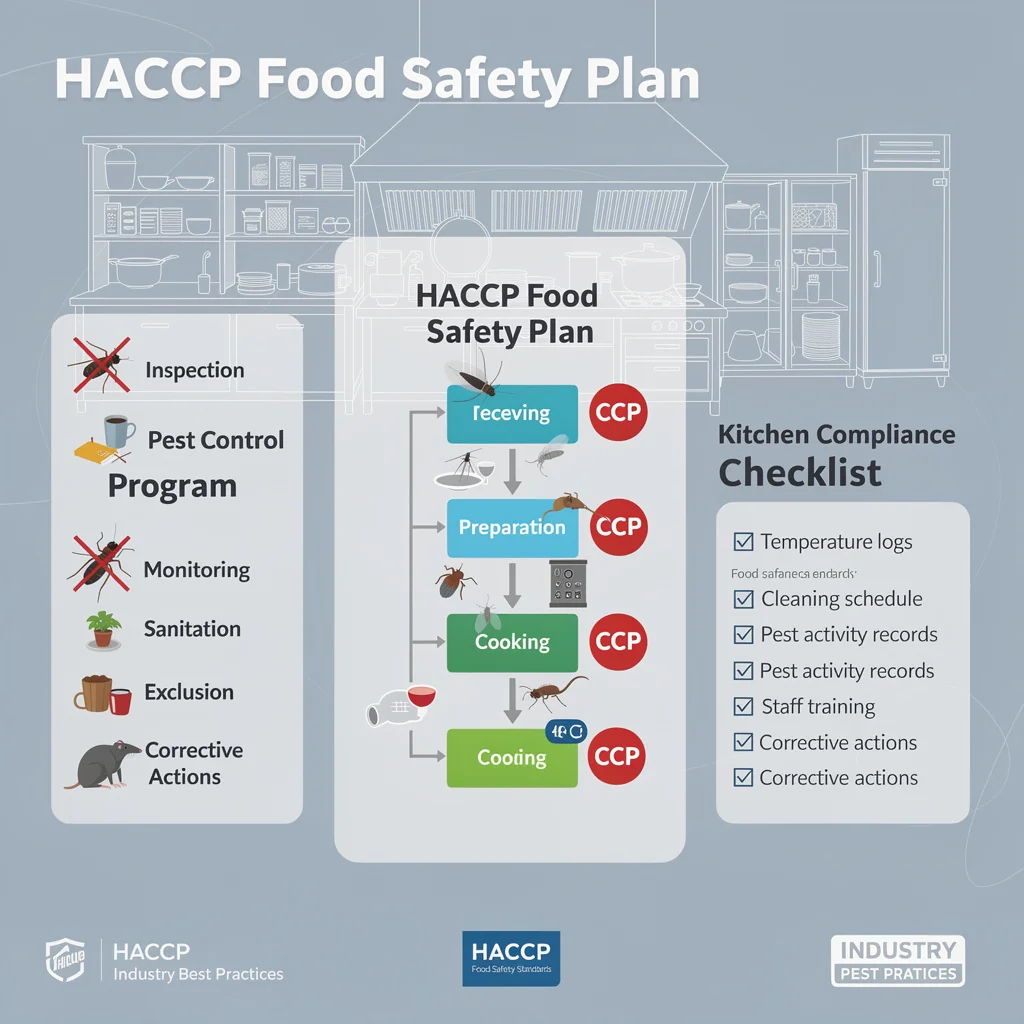
Pests are biological hazards that can contaminate food at any stage of production. Your pest control program must address seven key areas to satisfy HACCP requirements.
1. Risk Assessment
Documented assessment of pest risks specific to your facility, including building vulnerabilities, surrounding environment, and historical pest activity.
2. Exclusion Measures
Physical barriers preventing pest entry: door seals, window screens, air curtains, and sealed openings. Documented inspection and maintenance schedules.
3. Sanitation Integration
Cleaning protocols that eliminate food sources and harborage. Pest control recommendations incorporated into sanitation schedules.
4. Treatment Protocols
Approved treatment methods using only chemicals permitted in food premises. Application restricted to non-production hours with documented re-entry procedures.
5. Monitoring Systems
Continuous monitoring through devices (glue boards, bait stations, pheromone traps) with documented placement maps and inspection frequencies.
6. Corrective Actions
Predefined procedures for responding to pest sightings, including immediate response, root cause analysis, and preventive measures to prevent recurrence.
7. Documentation
Complete records of all pest control activities, monitoring results, corrective actions, and trend analysis. Documents must be audit-ready at all times.
Records
Required Documentation
HACCP auditors will examine your pest control documentation in detail. Missing or incomplete records are common findings that can result in non-conformities. Ensure these documents are complete, current, and readily accessible.
contract Service Contract
Current contract with licensed pest control operator specifying scope, frequency, and responsibilities.
description Service Reports
Detailed report for every service visit including findings, treatments applied, and recommendations.
map Site Plan & Device Maps
Maps showing locations of all monitoring devices, bait stations, and entry points.
bug_report Pest Sighting Log
Record of all pest sightings including date, location, pest type, action taken, and resolution.
Complete Document Checklist
Tip: Organise documents chronologically in a dedicated pest control file. Auditors expect to find records quickly.
Procedures
Monitoring & Audit Preparation
Daily Monitoring
Staff should check monitoring devices daily during routine inspections. Any pest activity, damaged devices, or displaced stations must be recorded immediately and reported to the pest control provider.
Weekly Reviews
Review pest sighting logs and monitoring records weekly. Look for patterns or trends that may indicate emerging issues. Ensure corrective actions from the previous week were completed.
Monthly Service Visits
Your licensed pest control operator should conduct thorough inspections monthly (minimum). Service reports must detail findings, treatments applied, and recommendations for improvement.
Quarterly Reviews
Conduct management review of pest control program effectiveness. Analyse trends, review incidents, and update risk assessments. Document decisions and actions in management meeting minutes.
fact_check Audit Preparation Checklist
Pre-Audit Self-Inspection
Walk through with the mindset of an auditor. Look for pest evidence, gaps in exclusion, and documentation issues.
Organise Documentation
Ensure all records are complete, dated, and signed. Prepare summary reports of trending data.
Brief Your Team
Ensure staff understand pest control procedures and can answer basic questions about monitoring and reporting.
Schedule Pest Control Visit
Arrange service close to audit date to ensure all devices are fresh and any issues are addressed.
Avoid Non-Conformities
Common HACCP Pest Control Violations
Understanding common audit findings helps you proactively address issues before they become non-conformities.
Evidence of Pests
Live or dead pests, droppings, nesting materials, or gnaw marks found during audit. Critical non-conformity requiring immediate corrective action.
Missing Documentation
Incomplete service records, missing reports, or gaps in monitoring data. Auditors expect continuous, complete documentation.
Unlicensed Operator
Using pest control companies without valid PAL/APAL licences. Always verify and retain copies of current licences.
Poor Exclusion
Gaps under doors, broken screens, unsealed penetrations, or open windows without screens. Physical barriers must be maintained.
Inadequate Monitoring
Insufficient monitoring devices, poor placement, or lack of inspection records. Device maps must match actual installation.
No Corrective Actions
Pest sightings logged without documented corrective actions or follow-up. Each incident requires resolution evidence.
Document Package
HACCP Pest Control Document Package Checklist
This is the full set of documents an auditor expects to see under PRP 7 (Pest Control). Use this checklist before every internal or third-party audit to verify completeness. Uni Smart provides templates and digital copies of every item on this list to its HACCP and ISO 22000 clients.
Contracts & Licences
- check_circleSigned annual pest control service contract with PCO
- check_circlePAL/APAL licence copies for every assigned technician
- check_circlePublic liability insurance certificate (RM 1M+ minimum)
- check_circlePCO's own HACCP-compatible service procedure document
- check_circleWritten scope: pests covered, sites covered, service frequency
Site Plan & Device Maps
- check_circleSite floor plan with current bait-station locations numbered
- check_circleInterior rodent station location map
- check_circleInsect Light Trap (ILT) placement map with bulb-replacement dates
- check_circlePheromone trap map for stored-product pest (SPP) zones
- check_circleHigh-risk zone register (receiving, prep, storage, waste)
Service Records (12+ months)
- check_circleSigned monthly service reports (one per visit, all 12 months)
- check_circleActivity logs with device-by-device readings
- check_circlePhoto evidence on every report (date-stamped)
- check_circleTrend chart: monthly activity counts by zone
- check_circleYear-over-year comparison report
Chemical Records
- check_circleApproved chemical register (every product used on site)
- check_circleCurrent MSDS for each product (refreshed annually)
- check_circleApplication log (date, product, area, dose, technician)
- check_circleChemical storage inspection records (segregation, labelling)
- check_circleEquipment calibration logs (sprayers, dispensers)
Corrective Actions (CAPA)
- check_circleCAPA log for every pest activity finding
- check_circleRoot-cause analysis for each incident
- check_circleAction taken, by whom, completion date
- check_circleVerification of effectiveness (re-inspection)
- check_circleClosure sign-off by food safety manager
Annual Verification
- check_circleAnnual program review meeting minutes
- check_circleRisk assessment updated for current year
- check_circleService frequency adjustment (if needed)
- check_circleStaff training records (internal & external)
- check_circleManagement review sign-off (food safety team)
Auditor Perspective
Top 10 Things That Fail HACCP Pest Control Audits
Based on Uni Smart's experience supporting HACCP, ISO 22000, FSSC 22000, and BRC-accredited food businesses across KL and Selangor. Avoid these and your pest control PRP 7 will pass any third-party audit on the first visit.
Single technician across all visits for years
Auditors consider this a segregation-of-duties risk. The same person inspecting and approving creates a self-audit loop. Fix: Uni Smart assigns a primary technician plus a supervisor review visit at least quarterly.
Service reports without photos
A report that lists devices without photos doesn't meet PRP 7 verification standards. Fix: every Uni Smart report includes dated photos of devices and any findings.
Outdated MSDS (> 2 years old)
Chemical safety data sheets expire or get revised; outdated copies fail. Fix: Uni Smart refreshes MSDS annually and supplies current copies on request.
Bait station map doesn't match reality
If the auditor counts stations on site and the number differs from the map, it's an immediate finding. Fix: re-baseline the map after any structural changes; treat the map as a living document.
No structural maintenance link
Pest findings (gaps in walls, broken door seals, missing drain covers) often require building works. If pest reports flag these and there's no building work order, it's a finding. Fix: link PCO findings to your maintenance ticket system.
No trend analysis
Auditors want to see 12+ months of data and what it tells you. A spreadsheet of dates isn't a trend. Fix: Uni Smart provides trend dashboards with monthly comparison and zone-level analysis.
Activity without corrective action
A pest sighting logged with no root cause, no action, no closure. Fix: every finding generates a CAPA record with all four fields completed.
PDF or WhatsApp-only reports
Auditors want digital, searchable, date-stamped records. Screenshots of WhatsApp chats don't qualify. Fix: use a digital pest management platform — Uni Smart provides one.
Chemicals not approved for food premises
Category 1 or 1A products near food contact surfaces fail immediately. Fix: use only Category 3/3A products approved for food handling environments.
No annual review minutes
HACCP requires management review of PRP 7 every 12 months. Missing review minutes is a finding. Fix: Uni Smart supports annual review meetings with trend data and program recommendations.
Internal Audit
PRP 7 Internal Self-Audit Checklist
Run this self-audit on your site every quarter (or monthly if you're ISO 22000 / FSSC 22000). Each Yes/No item maps to a specific HACCP, ISO 22000, or BRC requirement. Score < 80% means you should bring in Uni Smart for a pre-audit review before your next external visit. For a deeper walkthrough of how this fits into a full food-business program, see our complete guide to commercial pest control for Malaysian food businesses.
| # | Question | Standard | Pass? |
|---|---|---|---|
| 1 | Current signed PCO service contract on file and within renewal date? | HACCP / ISO 22000 | |
| 2 | PAL/APAL licences for current technicians (in date)? | HACCP / BRC | |
| 3 | Current public liability insurance certificate? | BRC / FSSC | |
| 4 | Site floor plan with current bait station locations? | HACCP | |
| 5 | Insect Light Trap (ILT) placement map current? | HACCP | |
| 6 | 12+ months of signed monthly service reports archived? | HACCP / ISO 22000 | |
| 7 | Every service report includes dated photos? | ISO 22000 / BRC | |
| 8 | Trend chart showing monthly activity counts available? | HACCP / BRC | |
| 9 | Approved chemical register with current MSDS for each product? | HACCP / BRC | |
| 10 | Chemical storage inspected, segregated, and labelled correctly? | HACCP / ISO 22000 | |
| 11 | CAPA log for every pest sighting in past 12 months? | HACCP / ISO 22000 | |
| 12 | Structural issues flagged by PCO linked to work orders? | ISO 22000 | |
| 13 | Annual PRP 7 review meeting held and minuted? | HACCP / FSSC 22000 | |
| 14 | Food handler pest-awareness training records on file? | HACCP | |
| 15 | Drain cleaning schedule documented and running? | HACCP / BRC |
Scoring: 13–15 pass · 10–12 needs work · < 10 book a pre-audit review
event_available Book a Pre-Audit ReviewWritten & reviewed by Uni Smart Pest Control
This guide is prepared by the Uni Smart Pest Control technical team, licensed pest control operators (PAL/APAL) with years of experience serving residential, commercial, and food-safety clients across Kuala Lumpur, Selangor, and Putrajaya. We combine field-tested treatment methods with HACCP, MOH, and ISO 22000 compliance knowledge to help Malaysian property owners make informed pest management decisions.
FAQ
HACCP Pest Control Questions
Is pest control mandatory for HACCP certification? expand_more
What documentation is required for HACCP pest control? expand_more
How often should pest control be done for HACCP compliance? expand_more
Can I use any pest control company for HACCP compliance? expand_more
What happens if pests are found during a HACCP audit? expand_more
HACCP-Compliant Pest Control
Uni Smart Pest Control provides HACCP-compliant pest management for food businesses across Malaysia. Our service includes complete documentation, audit support, and staff training.
Related pest control pages
Looking for a full-service commercial partner? See our commercial pest management programs for restaurants, food factories, and hospitality. Also explore All resources, About Uni Smart, All services, Areas we serve, Free site visit.